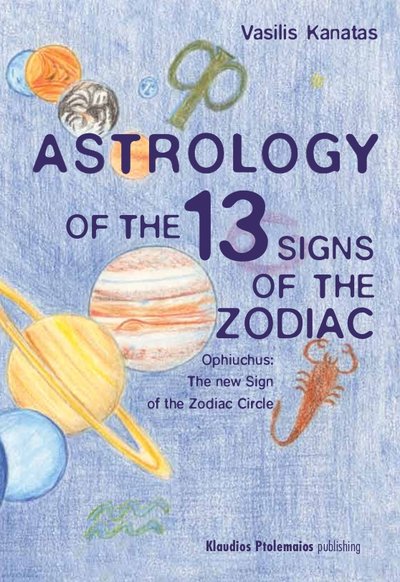
Star Maps, Myths and Exoplanets – My New Book
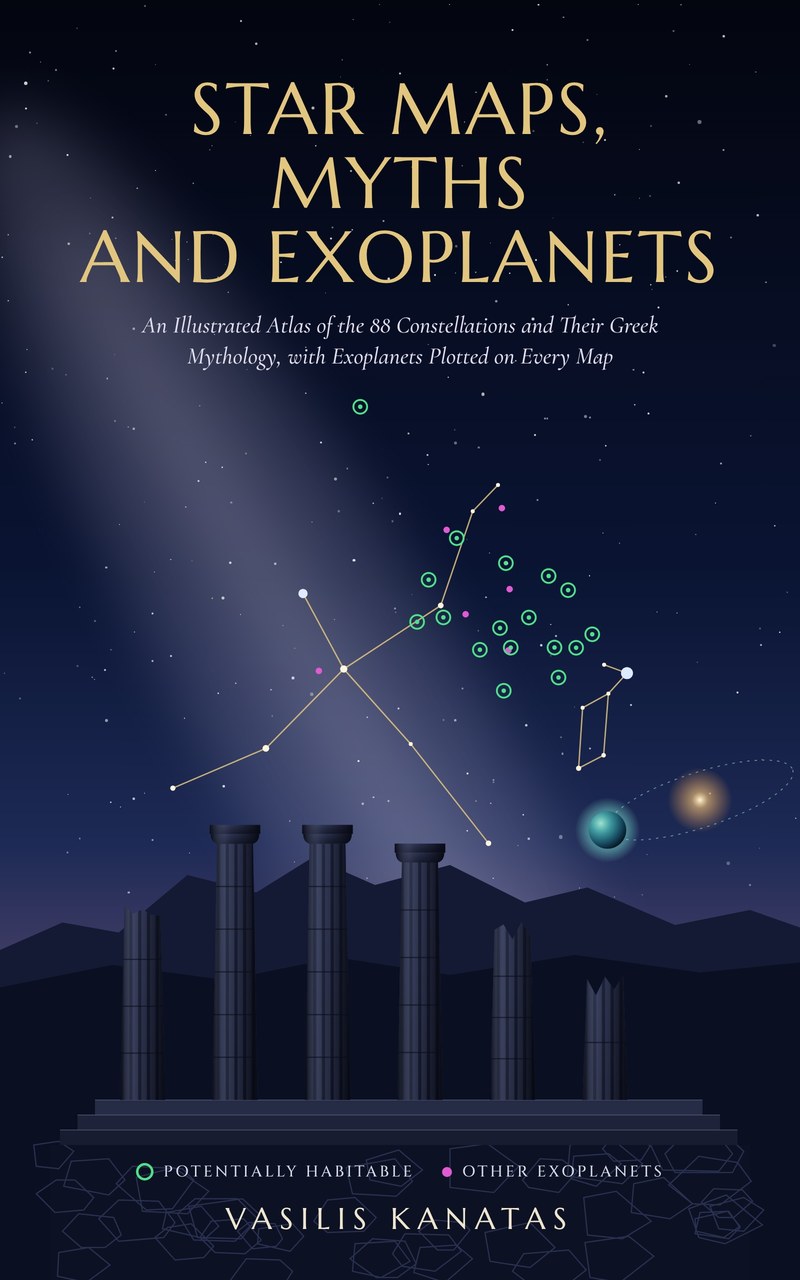
Look up at the night sky and you can read two stories at once: the myths the ancient Greeks wrote among the stars, and the new worlds astronomers have found circling those same stars. My new book, Star Maps, Myths and Exoplanets, brings the two together for the first time in a single atlas.
Paperback in full colour – $29.99 Kindle eBook – $9.99 or free with Kindle+
Double Retrograde in Virgo: Why Mercury and Venus Seem to Walk Backward
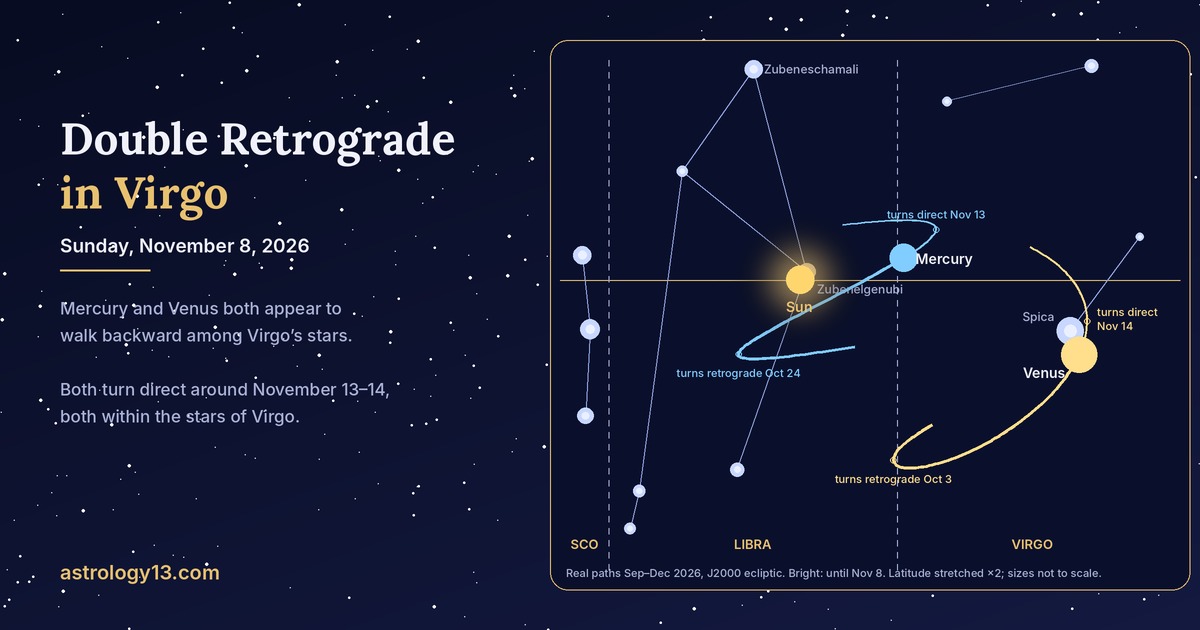
For a few days this November, two of our closest neighbours are doing something that has fascinated sky-watchers for thousands of years. Both Mercury and Venus appear to move backward against the stars, and in the real sky they are doing it in the same constellation: Virgo.
What retrograde motion really is
No planet ever stops or reverses in its orbit. Retrograde motion is an effect of perspective. Mercury and Venus orbit the Sun inside Earth's orbit and move faster than we do. When one of them passes between the Earth and the Sun, an alignment called inferior conjunction, it overtakes us on the "inside lane". For a few weeks around that moment, its position against the distant stars appears to slide westward instead of eastward.
Venus reached inferior conjunction around October 23–24, 2026, and Mercury on November 4. That is why both are retrograde at the same time. Venus has been moving backward since October 3, and Mercury since October 24. Both turn direct again around November 13–14, 2026.
Read more: Double Retrograde in Virgo: Why Mercury and Venus Seem to Walk Backward
The Taurids: Autumn Fireballs from the Bull (Taurus)
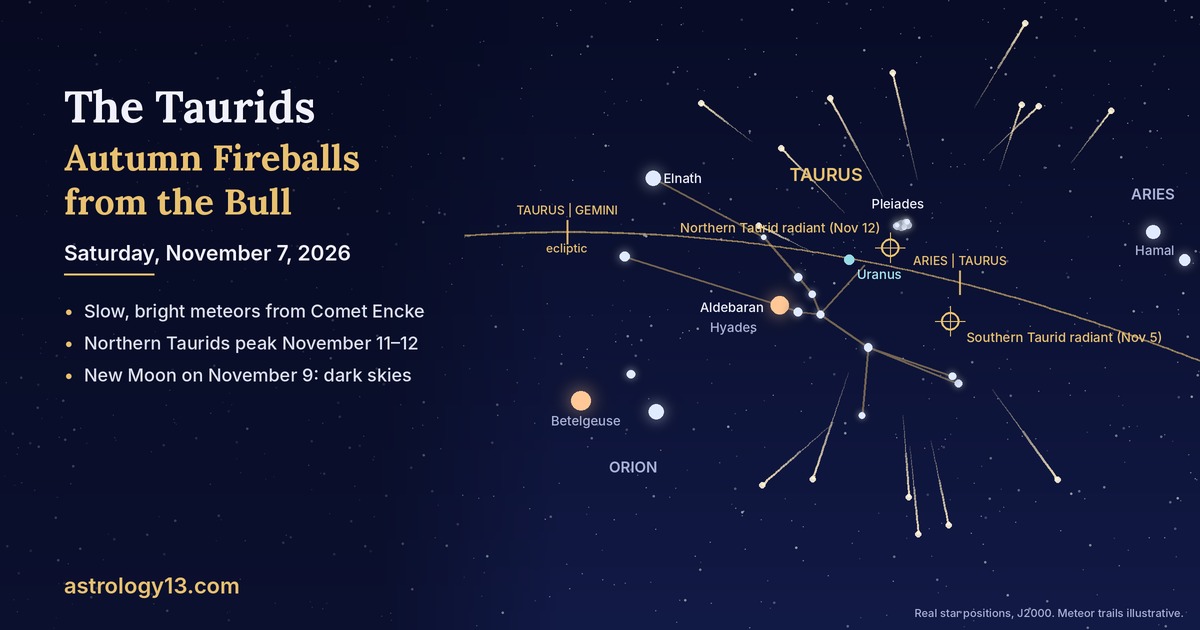
If you are outdoors on a dark November night and see a slow, bright meteor gliding across the sky, there is a good chance it is a Taurid. This modest but much-loved meteor shower is active right now, and 2026 offers it a gift: a New Moon on November 9, just before the Northern Taurids reach their peak.
Two Showers from One Comet
The Taurids are really two streams of debris. The Southern Taurids are active from about September 20 to November 20 and peaked around November 4–5. The Northern Taurids run from about October 20 to December 10 and peak on the nights of November 11–12. Both come mainly from Comet 2P/Encke, which has one of the shortest orbits of any known comet, returning to the Sun every 3.3 years. Over thousands of years it has scattered a wide trail of dust and pebbles along its path, and the Earth crosses that trail every autumn.
Read more: The Taurids: Autumn Fireballs from the Bull (Taurus)
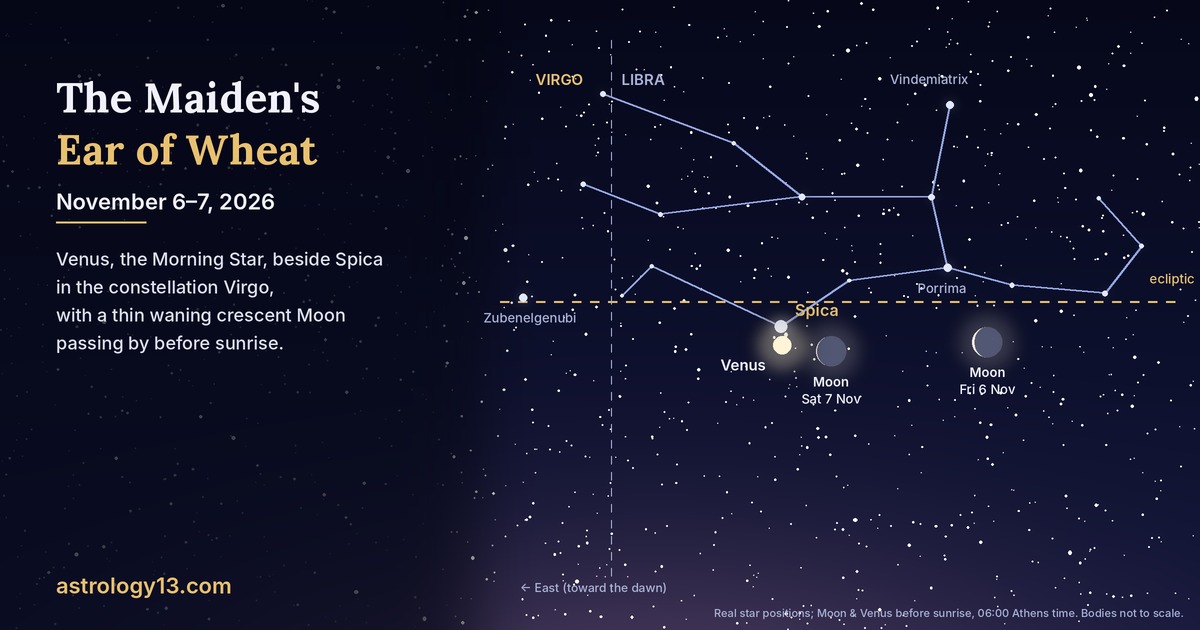
Spica, the Maiden’s Ear of Wheat: Venus and the Crescent Moon Meet in Virgo
This weekend the dawn sky offers one of the loveliest sights of the autumn. Low in the east-southeast before sunrise, Venus, the brilliant Morning Star, is shining right next to Spica, the brightest star of Virgo. On Saturday, November 7, a very thin crescent Moon joins them, completing a delicate trio against the stars of the Maiden.
A Gathering in the Real Constellation of Virgo
In the 13-sign zodiac, which follows the real constellations, Venus and the Moon are both in Virgo (September 17 – October 30) this weekend, even though the Sun itself has already moved on to Libra (October 31 – November 22). Venus is retrograde at the moment, slowly drifting westward. It turns direct around mid-November and stays close to Spica for the rest of the month.
On Friday morning, November 6, the crescent Moon, about 8% lit, stands higher up and to the right of Venus. By Saturday morning it has slipped down to just a few degrees from the planet and the star, only about 4–5% illuminated. Look about 45 minutes before sunrise, with a clear view of the horizon. Venus is unmistakable; binoculars will help you catch the Moon and Spica in the brightening twilight. The next Venus, Moon and Spica gathering this close will not happen until 2034.
Who Is the Maiden?
Virgo is the largest constellation of the zodiac and the second-largest in the whole sky. The Greeks saw in it several goddesses. For the poet Aratus, she was Dike, or Astraea, the goddess of justice, who lived among people in the Golden Age. As humanity grew greedy and violent, she withdrew to the mountains and finally rose to the sky, where she still shines beside the Scales of Libra.
Others saw her as Demeter, the goddess of grain and harvest, or her daughter Persephone. That is why the Maiden is often pictured holding an ear of wheat, and the name Spica means exactly that: "the ear of grain" in Latin. In ancient times, the Sun's passage through Virgo coincided with the harvest.
Read more: Spica, the Maiden’s Ear of Wheat: Venus and the Crescent Moon Meet in Virgo
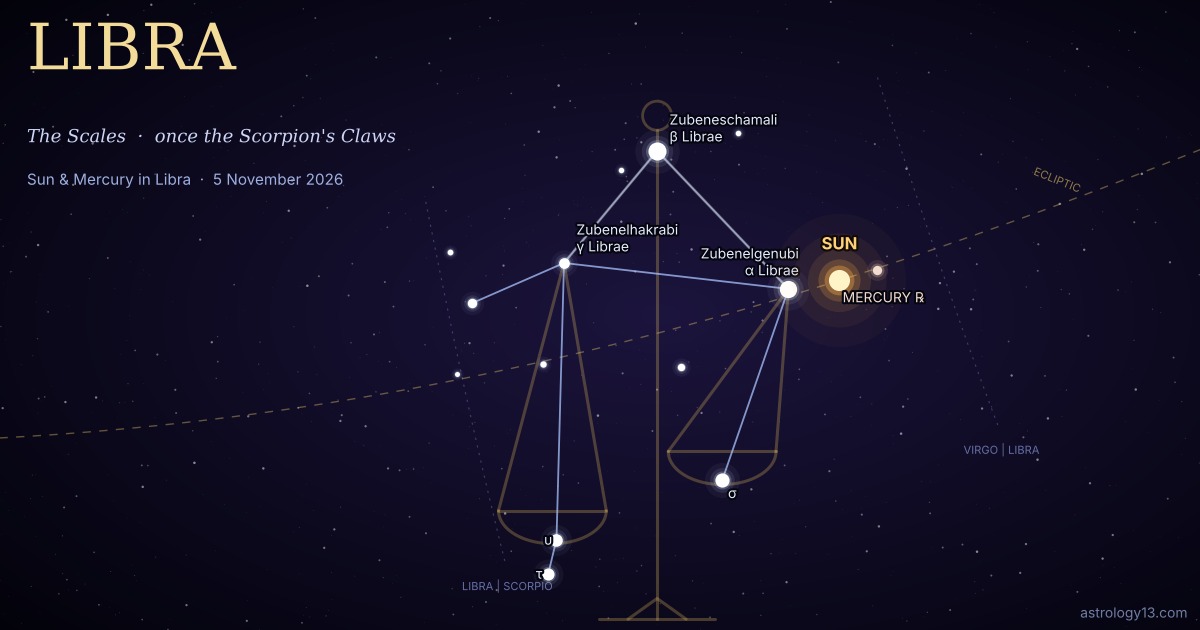
Libra: The Scales That Were Once a Scorpion’s Claws
Right now the Sun is passing in front of the stars of Libra, the only figure in the zodiac that is an object rather than a living being. In 13-sign astrology, which follows the real constellations, the Sun stays in Libra (October 31 – November 22) before moving on to Scorpio (November 23 – November 29). Libra is faint and easy to overlook, yet it has one of the most interesting stories in the sky.
From Claws to Scales
For the ancient Greeks, these stars did not form a constellation of their own. They were the Chelae, the outstretched claws of the great Scorpion next door. Even in Ptolemy's Almagest, the standard star catalogue of antiquity, the region still appears under the name "the Claws".
The idea of a balance is older still. Babylonian astronomers already linked this part of the sky with scales, and the Romans later revived the image and made Libra a firm member of the zodiac. In their version, the scales often belong to the neighbouring maiden Virgo, pictured as Astraea, the goddess of justice.
Star Names That Remember the Past
The old claws survive in the names of Libra's two brightest stars. Zubenelgenubi (Alpha Librae) means "the southern claw", and Zubeneschamali (Beta Librae) means "the northern claw". Both come from Arabic and preserve the time when Libra was part of Scorpius.
Zubenelgenubi lies about 77 light-years from us. Binoculars show it as a wide pair of stars. It also sits very close to the ecliptic, the path of the Sun, so the Moon and the planets often pass near it. Zubeneschamali is the constellation's brightest star, roughly 185 light-years away. Some observers have described it as having a greenish tint, although most people see it as blue-white.
Read more: Libra: The Scales That Were Once a Scorpion’s Claws
Page 2 of 8