The Moon Visits Saturn and Neptune in the Fishes
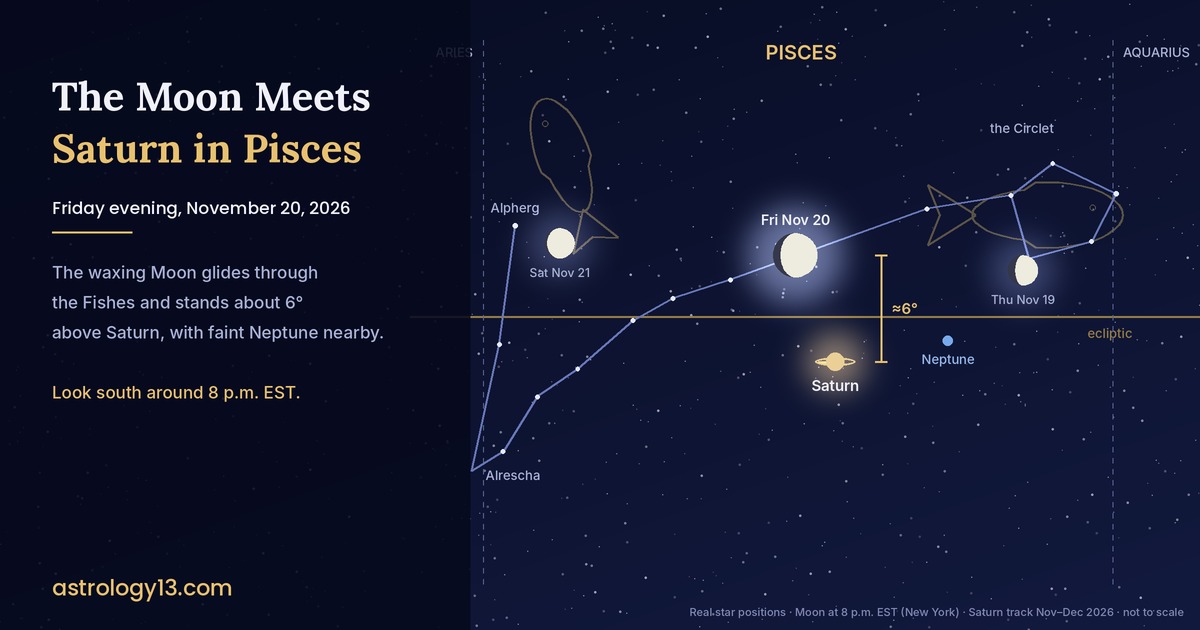
This week the waxing Moon swims into Pisces, the second-widest constellation on the zodiac road, and on Friday evening, November 20, it pauses just above Saturn. It is one of the easiest sky meetings of the season to find: look south after dinner, and the bright Moon will point straight down to the ringed planet.
What is happening in the sky
The Moon leaves Aquarius and enters Pisces on Thursday, November 19, at 10:20 a.m. EST. Early on Friday, around 4 a.m. EST, it passes 4.4 degrees north of Neptune, the faint blue giant that has been drifting slowly backward through the Fishes. That same afternoon it catches up with Saturn: the two share the same ecliptic longitude at 3:50 p.m. EST, with the Moon about 6 degrees to the north.
The alignment is only a matter of perspective. The Moon is a little more than one light-second away from us, while Saturn lies 8.75 AU from Earth, so the sunlight you see bouncing off it left the planet about 73 minutes earlier. Neptune is 29.3 AU away, and its light needs just over four hours to reach us.
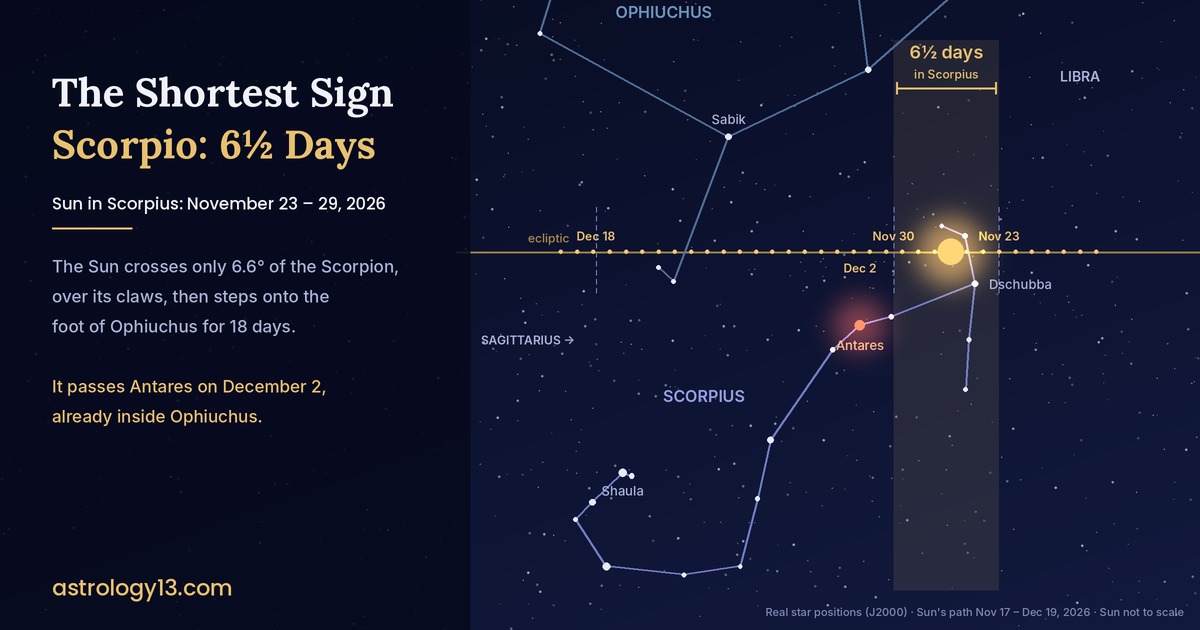
The Shortest Sign: The Sun's Six-and-a-Half-Day Visit to Scorpio
Next Monday, November 23, the Sun crosses into the constellation Scorpius. Less than a week later it is gone again. Of all the thirteen constellations the Sun visits along the ecliptic, the Scorpion gets the briefest stay, and the reason is written in the real shape of the sky.
What is happening in the sky
The Sun enters Scorpius on Monday, November 23, 2026, at 12:42 p.m. EST, at ecliptic longitude 241.07° (J2000). It crosses into Ophiuchus on Monday, November 30, at 12:46 a.m. EST, at longitude 247.65°. That is a stretch of only 6.6 degrees, which the Sun covers in six days and twelve hours. Tropical astrology gives Scorpio a full 30 degrees; in the real sky, Virgo alone spans about 44 degrees of the ecliptic.
Why so short? The constellation borders were fixed by the International Astronomical Union in 1930, following the stars themselves. Most of the Scorpion's body, from its heart to its curling tail, lies south of the Sun's path. Only its head, the claw stars Dschubba and Acrab, touches the ecliptic. Just to the east, the long figure of Ophiuchus, the Serpent Bearer, steps down across the ecliptic. So the Sun walks over the Scorpion's head and straight onto the foot of Ophiuchus, where it stays 18 days.
Here is the surprise. Antares, the red heart of the Scorpion, sits at ecliptic longitude 249.76°, beyond the border where the Sun leaves Scorpius. The Sun passes 4.6° north of Antares on Wednesday, December 2, at about 2:47 a.m. EST, when it is already in Ophiuchus. The heart belongs to the Scorpion, but the Sun meets it in the Serpent Bearer's domain. The Sun is then 0.986 AU from us, about 8.2 light-minutes, while the light of Antares has traveled roughly 550 years.
Read more: The Shortest Sign: The Sun's Six-and-a-Half-Day Visit to Scorpio
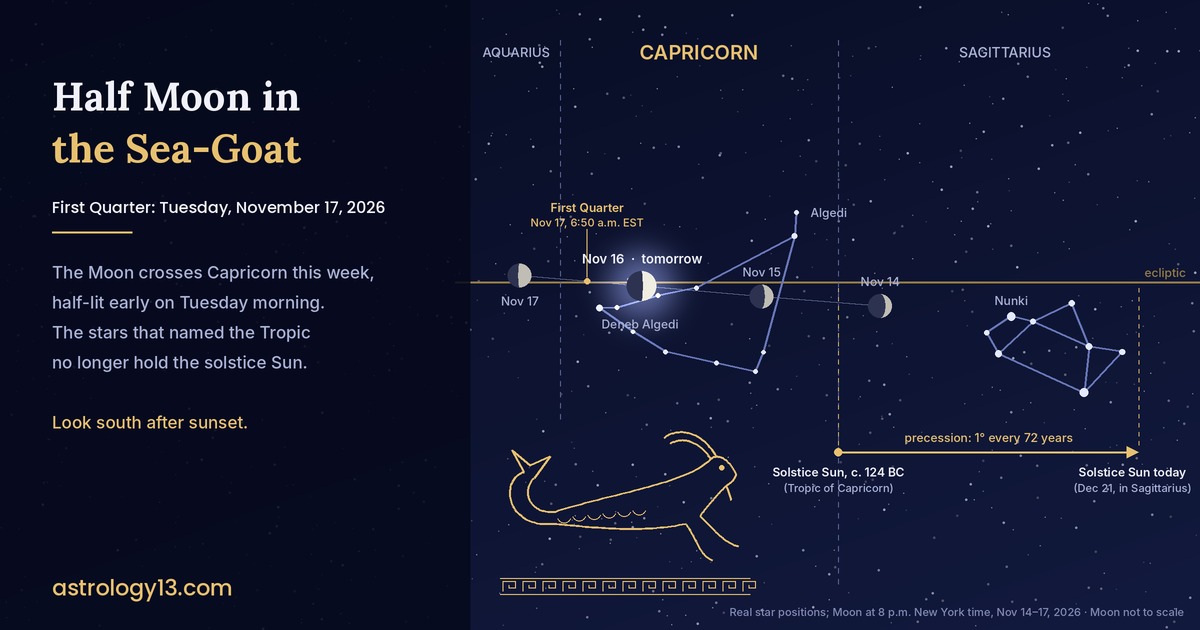
Half Moon in the Sea-Goat: Capricorn and the Tropic That Moved
This week the Moon offers an easy invitation to look up. On Tuesday, November 17, at 6:50 a.m. EST, it reaches First Quarter: exactly half of its face is lit by the Sun. It stands among the stars of Capricorn (January 20 – February 15), the ancient Sea-Goat. That small coincidence opens a big story about how the sky slowly changes.
What is happening in the sky
At First Quarter the Moon has travelled a quarter of its orbit since the New Moon of November 9. Seen from Earth, it now sits 90° east of the Sun. Sunlight strikes it from the side, so we see a sharp straight line between the bright western half and the dark eastern half. Along that line, the terminator, craters and mountains throw long shadows, and even binoculars show remarkable detail.
On Monday evening the Moon is about 45% lit and lies near the faint star Iota Capricorni. Overnight it slides about 3° north of Deneb Algedi, the "tail of the goat" and the brightest star of the constellation. At 12:12 p.m. EST on Tuesday it crosses the border into Aquarius (February 16 – March 11).
Read more: Half Moon in the Sea-Goat: Capricorn and the Tropic That Moved
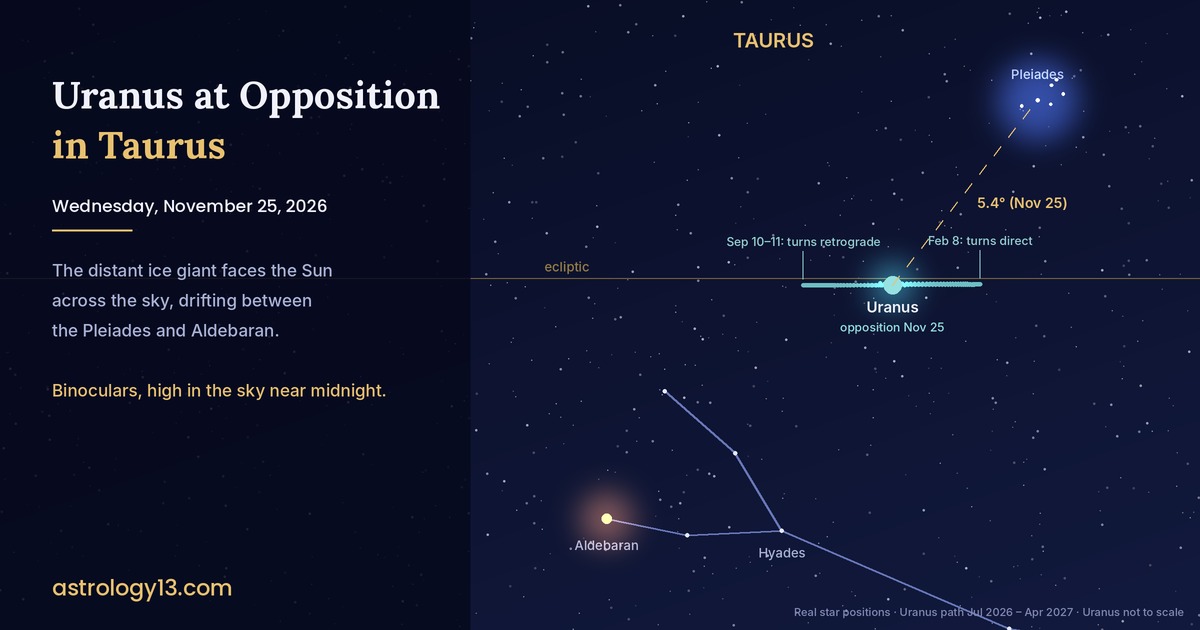
Uranus at Opposition in Taurus: The Ice Giant Between the Pleiades and Aldebaran
Most of us have never knowingly seen Uranus, yet the seventh planet is now at its best for the whole year. On Wednesday, November 25, 2026, Uranus reaches opposition in the constellation Taurus. It rises at sunset, stays up all night and stands highest around one o'clock in the morning. If you have a pair of binoculars, the next few nights are a perfect time to find it.
What is happening in the sky
At opposition, Earth passes between the Sun and Uranus, so the planet lies directly opposite the Sun in our sky. This is when it is closest to us and fully lit. Close is a relative word here: even on November 25, Uranus is 18.4 astronomical units from Earth, about 2.76 billion kilometres. Its reflected sunlight needs about 2 hours and 33 minutes to reach your eyes, so you see the planet as it was well before you stepped outside.
Since September 10–11, Uranus has been moving backward (retrograde) against the stars, and it will keep doing so until February 8, 2027. The planet is not really reversing. Our faster Earth, which needs one year for an orbit, is simply overtaking a world that needs 84 years for one lap around the Sun. Seen from the moving Earth, the slow outer planet seems to drift west for a few months.
Read more: Uranus at Opposition in Taurus: The Ice Giant Between the Pleiades and Aldebaran
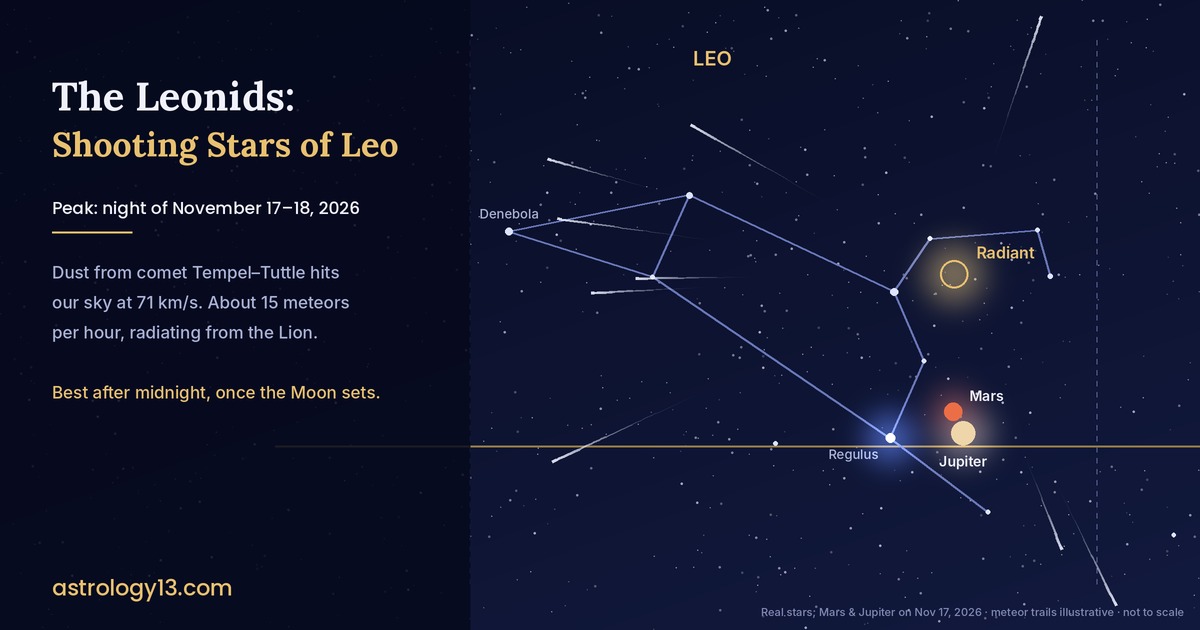
The Leonids: Shooting Stars from the Lion
Every November, the sky offers a small celebration for anyone willing to stay up late. The Leonid meteor shower is active from early to late November, and in 2026 it reaches its peak on the night of Tuesday, November 17, into the early hours of Wednesday, November 18. The meteors seem to fly out of the constellation Leo, the Lion, and this year they share that part of the sky with Mars, Jupiter and Regulus.
What is happening in the sky
The Leonids come from comet 55P/Tempel–Tuttle, which orbits the Sun about once every 33 years. Each time it passes close to the Sun, it sheds dust and tiny grains along its path. Every November, the Earth crosses this stream of debris, and the grains enter our atmosphere at about 71 kilometres per second, making the Leonids the fastest of the major meteor showers. Many leave bright, quick streaks, and some leave glowing trails that last a few seconds.
All the meteors seem to come from one point in the sky, called the radiant, inside the "Sickle" of Leo, the backward question mark that forms the Lion's head and mane. This is a perspective effect: like snowflakes in a car's headlights, parallel paths appear to spread out from a single point.
Page 1 of 9