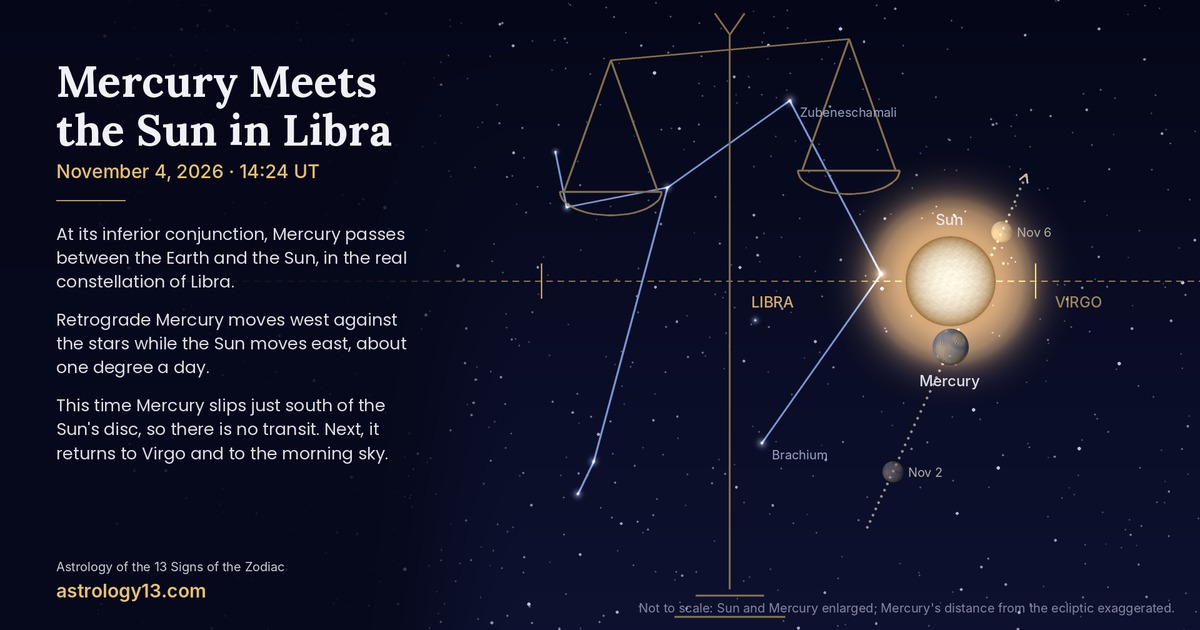
On Wednesday, November 4, 2026, at about 14:24 UT (16:24 Greek time), the planet Mercury passes between the Earth and the Sun. Astronomers call this moment an inferior conjunction. It marks the midpoint of Mercury's current retrograde loop – and it takes place against the stars of Libra, not Scorpio, where tropical horoscopes place it.
What is an inferior conjunction?
Mercury and Venus are the two "inferior" planets: their orbits lie inside the Earth's. Twice in each cycle they line up with the Sun as seen from Earth. When a planet is on the far side of the Sun, we speak of a superior conjunction. When it swings between us and the Sun, at its closest to Earth, it is an inferior conjunction.
Mercury is the fastest planet in the Solar System, so it repeats this cycle about every 116 days – three or four times a year. Around inferior conjunction, Mercury turns its unlit side towards us and is completely lost in the Sun's glare. You could call it a "new Mercury", much like a New Moon.
Why there is no transit this time
Mercury's orbit is tilted by about 7 degrees to the Earth's, so at most inferior conjunctions it passes above or below the Sun. It can cross the solar disc – a transit – only when the conjunction falls close to the points where its orbit crosses ours, which the Earth passes around May 8 and November 10 each year.
This November's conjunction comes close, but not close enough: Mercury slips just over a third of a degree south of the Sun's centre, a little more than the Sun's own radius. It narrowly misses the disc. The next transit of Mercury will have to wait until November 13, 2032.
A retrograde loop through Libra and Virgo
Mercury turned retrograde on October 24 – the same day Venus passed through its own inferior conjunction. Over the coming days Mercury keeps sliding backwards, leaving Libra for Virgo around November 8, where it will share the constellation with retrograde Venus. Mercury turns direct on November 13 while still in Virgo, and returns to Libra around November 20.
Then comes its best morning show of the year for northern observers. On November 21, Mercury reaches its greatest western elongation, about 19.6 degrees from the Sun. Look low in the east-southeast before sunrise, roughly an hour before the Sun comes up, for a small, steady point of light.
Mercury in Libra, in the real sky
In the astrology of the 13 signs, the Sun is in Libra (October 31 – November 22), and today Mercury stands right beside it. Because of the precession of the equinoxes, the tropical zodiac has drifted by almost a full constellation from the real sky, which is why most horoscopes describe this event as "Mercury in Scorpio".
Symbolically, an inferior conjunction is a seed moment: the old thinking cycle ends and a new one quietly begins. In Libra, the constellation of the Scales, that fresh start touches fairness, dialogue and the art of finding balance between two points of view. It is a good time to listen before you speak, and to let ideas mature in silence before you share them.
The book Astrology of the 13 Signs of the Zodiac explains how to read the planets where they really are. Mercury's quiet meeting with the Sun today is a perfect example: invisible to the eye, yet precisely placed among the stars.
Vasilis Kanatas
Delphi, November 2026