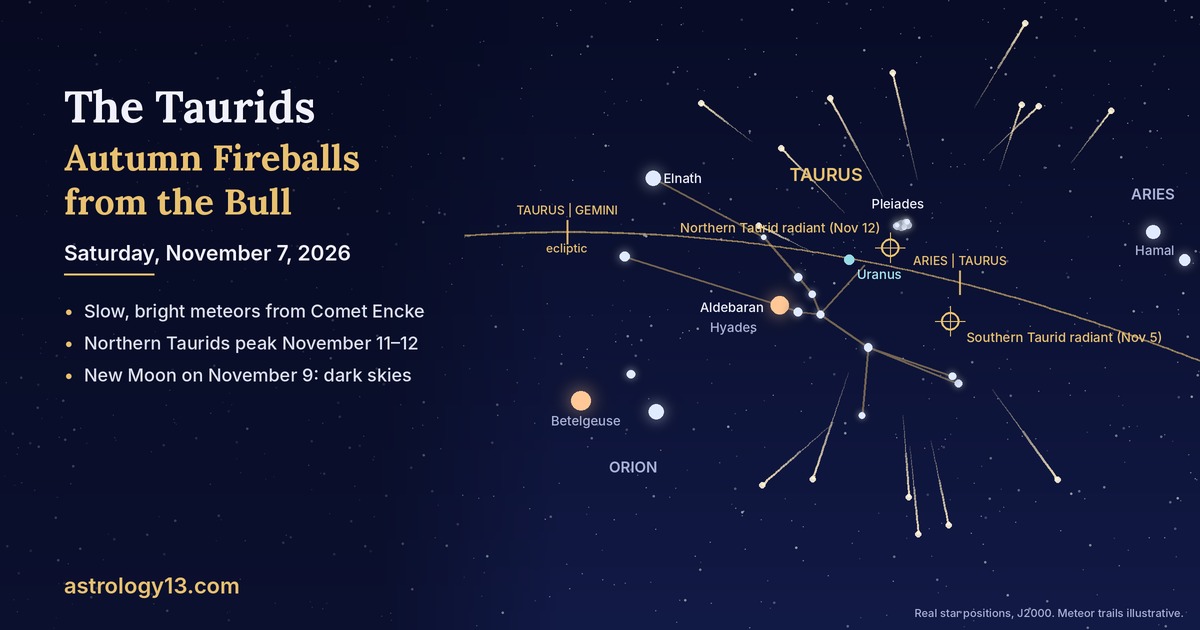
If you are outdoors on a dark November night and see a slow, bright meteor gliding across the sky, there is a good chance it is a Taurid. This modest but much-loved meteor shower is active right now, and 2026 offers it a gift: a New Moon on November 9, just before the Northern Taurids reach their peak.
Two Showers from One Comet
The Taurids are really two streams of debris. The Southern Taurids are active from about September 20 to November 20 and peaked around November 4–5. The Northern Taurids run from about October 20 to December 10 and peak on the nights of November 11–12. Both come mainly from Comet 2P/Encke, which has one of the shortest orbits of any known comet, returning to the Sun every 3.3 years. Over thousands of years it has scattered a wide trail of dust and pebbles along its path, and the Earth crosses that trail every autumn.
Slow Meteors, Bright Fireballs
Don't expect a storm. Each branch gives only about five meteors per hour under a dark sky. What makes the Taurids special is their style. They meet our atmosphere at less than 30 km per second, slow compared with many other showers, so they seem to drift across the sky rather than flash. The stream also carries larger particles than usual, which is why the Taurids are famous for fireballs: meteors brighter than Venus that can leave a glowing trail. Every few years the Earth passes through a denser part of the stream and fireballs become more frequent. 2026 is not expected to be one of these "swarm" years, but a few bright Taurids are likely all the same.
Where to Look
The meteors seem to fly out of a point called the radiant, which lies in the real constellation of Taurus, not far from the Pleiades star cluster and the red giant Aldebaran. Taurus rises in the evening and is highest around midnight, so the hours around midnight are best. With the New Moon on November 9 and only a thin crescent Moon setting early in the evening on November 11–12, the sky will be pleasantly dark. Find a spot away from city lights, let your eyes adapt for 20 minutes and look a little away from the radiant: Taurids can appear anywhere in the sky.
The Bull in the Real Zodiac
For the Greeks, Taurus was the white bull whose form Zeus took to carry the princess Europa across the sea to Crete. Only the front of the animal appears in the sky, as if it were rising from the waves. The Hyades form its face, Aldebaran its glowing eye, and the Pleiades ride on its shoulder. This autumn the Bull has a guest: the planet Uranus is moving slowly among its stars, between the Pleiades and the Hyades, and reaches opposition later this month.
In 13-sign astrology, which follows the real constellations, the Sun travels through Taurus (May 14 – June 20) much later than the dates printed in most horoscopes. If you were born in those weeks, the Bull is truly yours, and the Taurids are your meteors. Not sure which constellation the Sun was in when you were born? Try our Find Your True Zodiac Sign calculator, and discover more about every sign in the book Astrology of the 13 Signs of the Zodiac.
Vasilis Kanatas, Delphi, November 2026