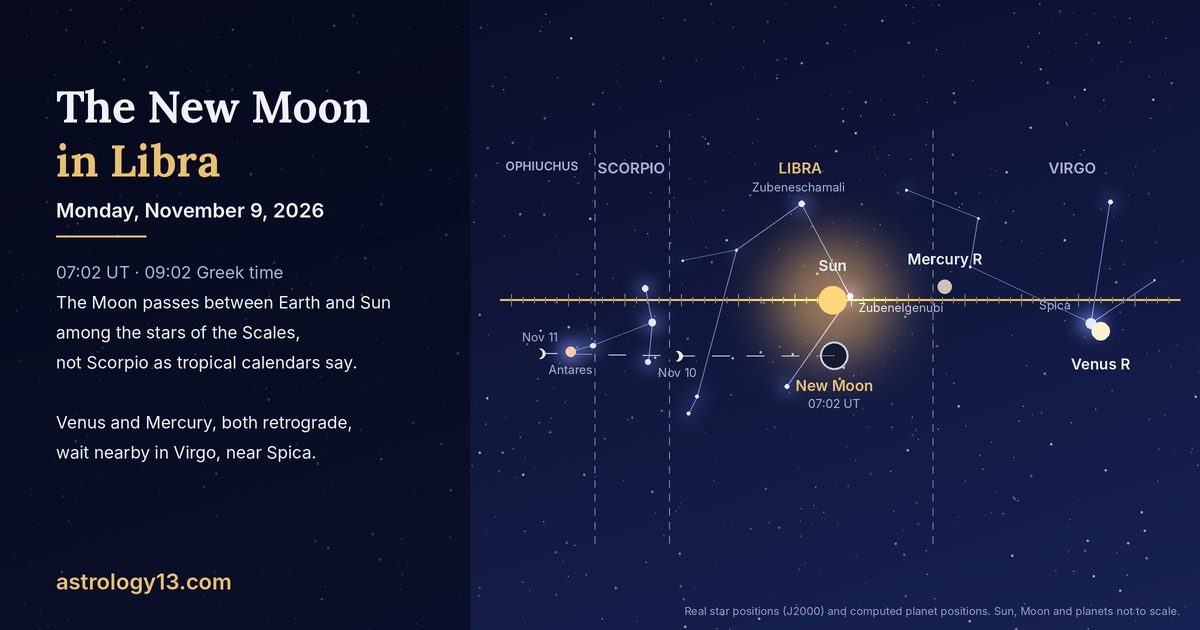
On Monday, November 9, 2026, at 07:02 UT (09:02 Greek time), the Moon reaches its new phase. For a few hours it lines up between the Earth and the Sun and disappears completely from view. Many horoscopes will call this a "New Moon in Scorpio". Look at the real sky, though, and you will find the Sun and the Moon together in front of the stars of Libra.
What happens at a New Moon
The Moon is always half lit by the Sun. What changes from night to night is how much of that sunlit half we can see from Earth. At New Moon the Moon stands on the same side of the Earth as the Sun, so its bright face points away from us and its dark side faces us. It rises and sets with the Sun, hidden in daylight.
From one New Moon to the next takes about 29.5 days, the synodic month. Within a day or two after Monday, a slender crescent will appear low in the southwest just after sunset. Each evening it will grow a little thicker and climb a little higher, until the next Full Moon on November 24.
Why there is no eclipse this time
If the Moon passes between us and the Sun every month, why don't we get a solar eclipse every month? Because the Moon's orbit is tilted by about 5 degrees to the ecliptic, the Sun's path across the sky. On Monday the Moon passes almost 5 degrees south of the Sun, far too low to cover it. An eclipse happens only when a New Moon falls close to one of the two points where the Moon's orbit crosses the ecliptic. The next solar eclipses come in 2027, an annular one on February 6 and a long total eclipse on August 2.
Libra, not Scorpio
In the tropical zodiac, the Sun "enters Scorpio" in late October. In the real sky, the Sun has been crossing Libra (October 31 – November 22) since the end of October and will reach the stars of Scorpio (November 23 – November 29) only on November 23. Monday's New Moon falls just east of Zubenelgenubi, the "southern claw", one of the two brightest stars of the Scales. The difference comes from precession, the slow wobble of the Earth's axis, which has shifted the tropical signs by almost a whole constellation since they were defined some two thousand years ago.
The Moon will not stay in Libra for long. It moves about 13 degrees a day, so it crosses into Scorpio on Tuesday, November 10, and reaches Ophiuchus (November 30 – December 17), the Serpent Bearer, on Wednesday, November 11. There it passes very close to the red star Antares, though both will be lost in the Sun's glare.
A season of beginnings
Astrologers have long treated the New Moon as a time for planting seeds: setting intentions and starting projects. A New Moon in Libra, the constellation of balance, invites us to weigh what matters and to bring fairness into our relationships. With Venus and Mercury both retrograde nearby in Virgo, it is also a fine moment to finish what is half done before starting something new.
In Astrology of the 13 Signs of the Zodiac, every sign is read on the sky we can actually see, and the Moon is the clearest guide of all: it shows us the real constellations, night after night. Curious about where the Sun really stood when you were born? Find your true zodiac sign and meet your place among the stars.
Vasilis Kanatas, Delphi, November 2026