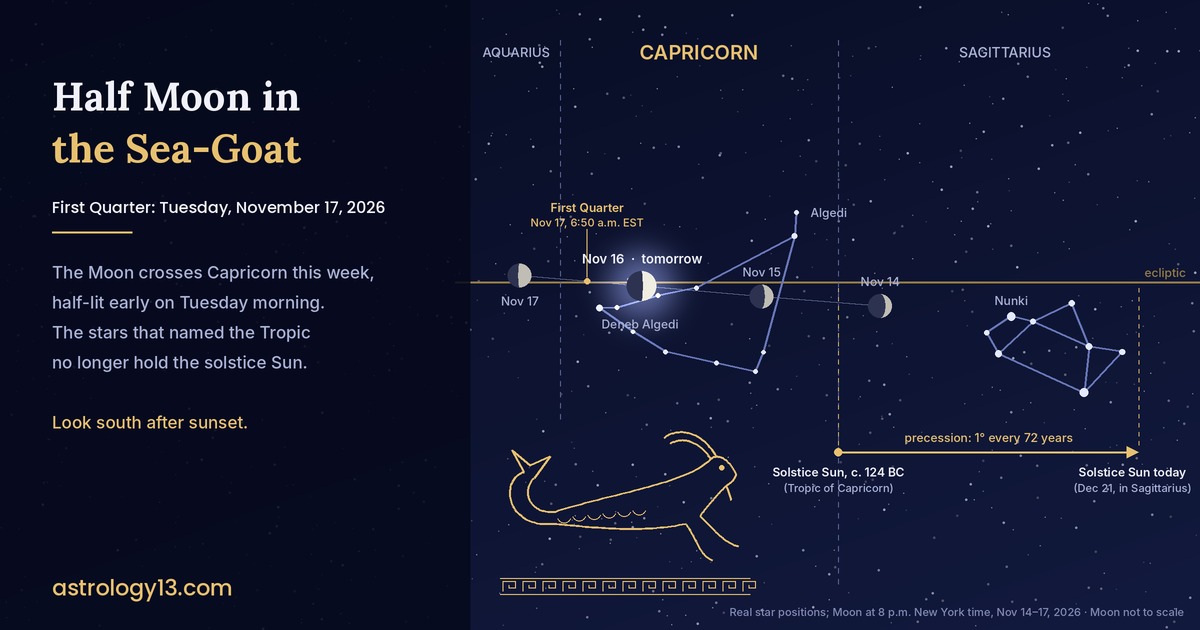
This week the Moon offers an easy invitation to look up. On Tuesday, November 17, at 6:50 a.m. EST, it reaches First Quarter: exactly half of its face is lit by the Sun. It stands among the stars of Capricorn (January 20 – February 15), the ancient Sea-Goat. That small coincidence opens a big story about how the sky slowly changes.
What is happening in the sky
At First Quarter the Moon has travelled a quarter of its orbit since the New Moon of November 9. Seen from Earth, it now sits 90° east of the Sun. Sunlight strikes it from the side, so we see a sharp straight line between the bright western half and the dark eastern half. Along that line, the terminator, craters and mountains throw long shadows, and even binoculars show remarkable detail.
On Monday evening the Moon is about 45% lit and lies near the faint star Iota Capricorni. Overnight it slides about 3° north of Deneb Algedi, the "tail of the goat" and the brightest star of the constellation. At 12:12 p.m. EST on Tuesday it crosses the border into Aquarius (February 16 – March 11).
How to see it
From New York the Sun sets at 4:37 p.m. EST on Monday. Look south at dusk: the Moon is about 33° high around 6 p.m. and sets at 10:52 p.m. On Tuesday evening, now just over half lit, it stands about 38° high at 6 p.m. and sets at 11:56 p.m. To its left, in the southeast, shines the steady golden point of Saturn in Pisces, about 8.7 AU away. Its light takes some 72 minutes to reach us.
The Tropic that moved
Why do maps show a "Tropic of Capricorn"? More than two thousand years ago, at the December solstice, the Sun stood among the stars of Capricorn. The line on Earth where the Sun is overhead on that day took the constellation's name.
But the Earth's axis wobbles slowly, like a spinning top, and the solstice point drifts westward along the ecliptic by about 1° every 72 years. Using the official constellation boundaries, the December solstice Sun left Capricorn around 124 BC. Today, on December 21, it shines in Sagittarius (December 18 – January 19), and around the year 2269 it will enter Ophiuchus (November 30 – December 17). The Tropic kept its old name, but the sky moved on.
The 13-sign view
This is the same precession that separates the traditional zodiac from the real sky, and the reason the Sun now crosses thirteen constellations rather than twelve. In Greek myth the Sea-Goat recalls Pan, who leapt into the Nile to escape the monster Typhon. The half that stayed above the water remained a goat, and the half below became a fish. It is a fitting symbol for a sign that lives between two worlds. In Astrology of the 13 Signs of the Zodiac you can read how each constellation's real dates reshape the familiar signs.
Curious where the Sun really stood on your birthday? Find your true zodiac sign and see which of the thirteen is yours.
Vasilis Kanatas, Delphi