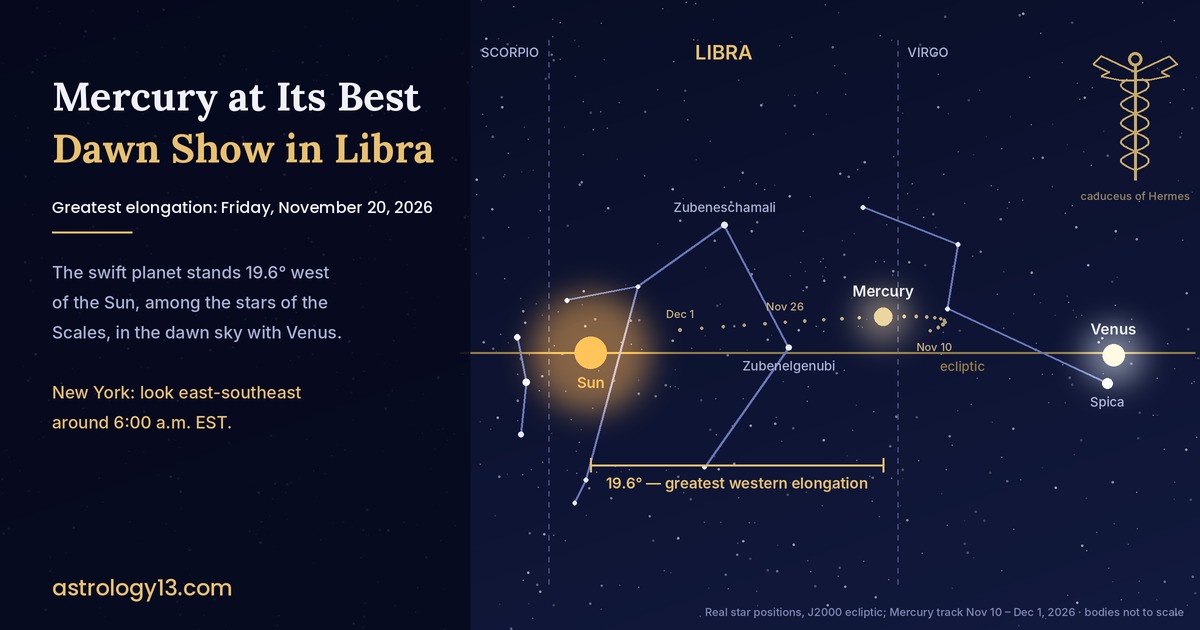
Mercury is the planet most people have never knowingly seen. It hugs the Sun so tightly that it usually hides in the glare. This week the small world steps out of hiding. On Friday, November 20, 2026, at 6:29 p.m. EST, Mercury reaches its greatest western elongation, 19.6 degrees from the Sun, and the mornings around that date offer the finest view of it this season from New York and across the USA.
What is happening in the sky
Mercury passed between Earth and the Sun earlier this month and has been climbing into the dawn sky ever since. Seen from Earth, it now swings out to the farthest point of its loop on the western side of the Sun, which places it in the morning sky. Today it lies 0.994 AU from us, so its light needs about 8.3 minutes to reach your eyes. Mercury shines at about magnitude −0.5, outshining every star in the night sky except Sirius and Canopus.
Why only 19.6 degrees? Mercury's orbit is the most elongated of all the planets. Its distance from the Sun swings between 0.31 and 0.47 AU, so some elongations reach 28 degrees while others barely exceed 18. Right now Mercury is just 0.34 AU from the Sun, close to its nearest point, which keeps this elongation modest. Fortunately, the steep angle of the autumn morning ecliptic lifts it high enough above the horizon for northern observers.
How to see it
In New York, Mercury rises at 5:08 a.m. EST, about an hour and forty minutes before the Sun (sunrise is at 6:47 a.m.). The best moment is around 6:00 a.m.: look east-southeast, where Mercury stands about 10 degrees high, roughly a fist held at arm's length above the horizon. You cannot miss Venus, blazing about 22 degrees high in the southeast; Mercury is the fainter, pale golden point below and to the left of it. A flat horizon helps, and binoculars help even more, but put them away before the Sun rises.
The show is not limited to one morning. Mercury stays well placed until about the end of November, still rising more than an hour before the Sun on November 30, and it disappears into the solar glow by mid-December.
The 13-sign view
On Thursday evening, at 5:59 p.m. EST, Mercury crossed from Virgo (September 17 – October 30) into Libra (October 31 – November 22), where the Sun itself is spending its last days before entering Scorpio (November 23 – November 29) on Monday. Tropical astrology places Mercury at 9 degrees of "Scorpio" today, but the real sky shows the planet among the stars of the Scales. On the morning of November 26, Mercury will pass less than two degrees north of Zubenelgenubi, the southern pan of the Scales, a lovely target for binoculars.
In my book, Astrology of the 13 Signs of the Zodiac, I explain why the positions we see in the sky, not the ones in old tables, describe our nature and our days. Mercury's dawn appearance in Libra is a perfect reminder: the planets keep their own appointments with the constellations.
Curious where the Sun really stood when you were born? Find your true zodiac sign now.
Vasilis Kanatas, Delphi