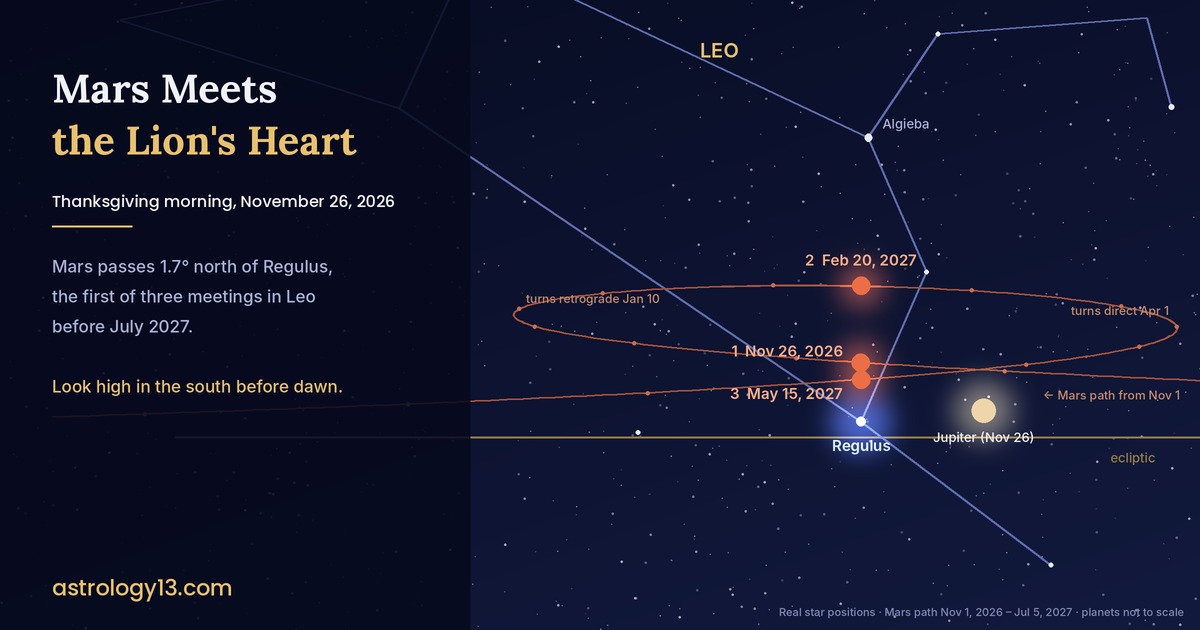
Before the turkey goes into the oven next Thursday, step outside and look up. In the early hours of Thanksgiving, November 26, 2026, the red planet Mars slides 1.7 degrees north of Regulus, the brightest star of Leo. It is the opening act of a rare celestial trilogy: Mars will pass Regulus three times in less than six months.
What is happening
Regulus sits only half a degree from the ecliptic, the Sun's yearly path, closer than any other first-magnitude star. That is why the Moon and the planets brush past it so often. This autumn Mars has been crossing Leo, and on November 16 it overtook Jupiter. Now it reaches the Lion's heart. The gap of 1.7 degrees is more than three full Moons placed side by side, close enough to frame both points in a pair of binoculars.
Jupiter stays in the picture too, about 3.6 degrees to the right of Regulus, so the morning sky holds a striking triangle: golden Jupiter, orange Mars and blue-white Regulus. The colors tell you which is which. Jupiter, at magnitude −2.3, is the brightest of the three; Mars, near magnitude +0.5, now outshines the star; Regulus glows at +1.4.
The alignment is only a perspective effect. On Thanksgiving morning Mars lies 1.22 astronomical units from Earth, so its light needs about 10 minutes to reach us. Regulus is roughly 79 light-years away. Jupiter's light, from 5.1 AU, travels 42 minutes.
How to see it from New York
Mars, Jupiter and Regulus climb above the eastern horizon around 11 p.m. EST on Wednesday night, November 25, but the best view comes before dawn. At 5 a.m. EST the trio stands about 60 degrees high in the south-southeast, and by 6 a.m. it has moved due south, still more than 60 degrees up. Sunrise is at 6:54 a.m. The brightest object in the sky at that hour is Venus, blazing low in the east-southeast, so do not mistake her for Jupiter. On any morning between November 23 and 29 you can watch Mars shift a little east each day, past the star.
Three passes, one Lion
Why three meetings? On January 10, 2027, Mars will stand still and begin moving backward, reaching opposition on February 19. On February 20 it passes Regulus again, this time about 4 degrees to the north and visible all night. Mars turns direct on April 1 and makes its third pass in mid-May, 1.2 degrees north of the star. In total, Mars remains inside the constellation Leo from November 1, 2026 to July 5, 2027, more than eight months.
The 13-sign view
In the sidereal zodiac of the 13 signs, this is all Leo territory: the Sun crosses the Lion from August 11 to September 16. Mars, the traditional ruler of Aries (April 19 – May 13), lingers for an unusually long season in the royal constellation, and Regulus, the "little king", was one of the four Royal Stars of ancient Persia. In my book, Astrology of the 13 Signs of the Zodiac, you can see why a planet's real position among the stars matters. Want to know which constellation the Sun really occupied when you were born? Find your true zodiac sign now.
Vasilis Kanatas, Delphi